She (H. Rider Haggard)
This post is part of Commonplace Classics, wherein I read the books we all know and sometimes love.
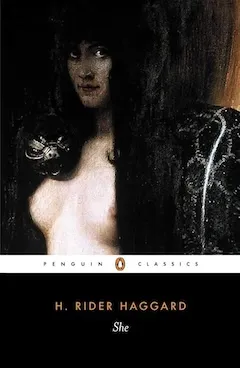
H. Rider Haggard's 1887 novel She is the tenth best-selling individual book of all time, outstripping modern blockbusters like The Da Vinci Code, The Bridges of Madison County, and all but one of the Harry Potter books. Popularity isn't the only domain in which She remains competitive: Haggard's opus is at least as bad as anything Dan Brown, J.K. Rowling, and whoever wrote The Bridges of Madison County have expelled from their cloacae.
It starts promisingly enough. Self-identified misogynist and Cambridge fellow Horace Holly - a man whose visage, in the course of the book, is likened to both a gorilla and a baboon - becomes the adoptive parent of a dead friend's young son, and the guardian of a mysterious locked box which is to be opened on the boy's twenty-fifth birthday. The boy, Leo, grows to be as hunky as Holly is hideous, and the pair duly open the box at the appointed time. Inside is an ancient potsherd, which instructs them to travel to Africa. Holly recounts all this with grave sobriety, and Haggard provides mocked up illustrations of the potsherd and explanatory footnotes that will continue through the book. It's an outlandish but (by the standards of adventure fiction) plausible set-up, and Haggard evidently thought well of himself for conceiving it. "It scarcely seemed likely that such a story could have been invented by anybody," says Holly. "It was too original."
Holly and Leo and their pious servant Job head off to Africa where they begin the important work of shooting at everything that flies, scurries, or so much as blinks. Eventually they are rescued/taken prisoner by a local tribe, the Amahagger, who cart them off to their troglodyte city where She-who-must-be-obeyed - usually shortened to She, respectfully italicised - awaits. She turns out to be a two thousand-year-old immortal white woman named Ayesha, a woman so white and so beautiful that mortal man cannot look upon her unveiled face without going insane with desire. Ayesha has been hanging around in the caves, occasionally smiting unruly Amahagger, waiting for her long-lost love to be reborn; Leo, of course, is the dead spit of the guy. Adventure ensues. Kinda.
Actually, mostly what ensues is talking. Considering Ayesha's been cooped up with her "savage" minions for millennia, it's only natural that she take the opportunity to hold forth to men of good breeding like Holly and Leo. And the good news is that even though she's out of touch with the main currents of human affairs, in some ways she is pure 19th century Brit. By which I mean she's quite racist1. Ayesha communicates using an archaic dialect of Arabic, which Holly and the others are also obliged to use, and which Haggard renders as, well, as this:
“For I do hope for an immortality to which the little span that perchance thou canst confer will be but as a finger’s length laid against the measure of the great world; and, mark this! the immortality to which I look, and which my faith doth promise me, shall be free from the bonds that here must tie my spirit down. For, while the flesh endures, sorrow and evil and the scorpion whips of sin must endure also; but when the flesh hath fallen from us, then shall the spirit shine forth clad in the brightness of eternal good, and for its common air shall breathe so rare an ether of most noble thoughts that the highest aspiration of our manhood, or the purest incense of a maiden’s prayer, would prove too earthly gross to float therein.”
If you can stomach page after page of that you're made of sterner stuff than I.
Some of the horror elements are fun. There's a pyramid of human skeletons, and a memorable scene in which the Amahagger use mummified corpses as portable bonfires. Ayesha's ultimate fate is appropriately grotesque, presaging the "He chose... poorly" scene from Indiana Jones. But mostly the book is either Holly's interminable musings on various subjects - including at one point an extended, vaguely erotic paean to an embalmed foot - and conversations with, or about, Ayesha, which, you'll recall, sound like this: “As yet thou hast no cause to fear me. If thou hast cause, thou shalt not fear for long, for I shall slay thee. Therefore let thy heart be light.” Smiting is too good for this lot.
Holly's declared misogyny sets up a potentially interesting dynamic with the all-powerful, ultra-feminine Ayesha. The Amahagger seem at first to have a surprisingly liberal matriarchal social structure, in which women "do what they please... because without them the world could not go on; they are the source of life". Holly is intrigued, "the matter never having struck me quite in that light before" - the birds and the bees not being part of a Cambridge education. But this enlightened approach is followed only "up to a certain point", after which the men rise up and "kill the old ones as an example to the young ones, and to show them that we are the strongest." Women might be "the source of life" but they are also the fathomless source of great evil. And that's just regular women! She, with her immortality and super powers and tortured rhetoric, is horror incarnate. Holly, contemplating She's designs on Leo, sums it up with a nineteenth century "take my wife" gag: "when had such a chance ever come to a man before as that which now lay in Leo’s hand? True, in uniting himself to this dread woman, he would place his life under the influence of a mysterious creature of evil tendencies, but then that would be likely enough to happen to him in any ordinary marriage.”
She has a lot in common with Dracula, published a decade later. Both novels centre an exotic, immortal villain, whose cunning plan is to infiltrate and ultimately dominate England. They share a paranoia about "the other" (foreigners, women, foreign women), and infection (vampirism, obviously, in Dracula; mesmeric, uncontrollable lust in She). Then there's the undercurrent of homoeroticism between the male leads: in Dracula, Lucy Westenra's three suitors, each more manly than the last, co-mingling their manly blood via transfusion; Holly and Leo, his "more than son", in She.) But Dracula, for all its structural flaws and utter humourlessness, retains its dreadful atmosphere and page-turning verve2. Dracula is fun! She, by contrast, is dramatically inert, tediously written, and a chore to read.
*
Next up, John Cheever's 1957 novel, The Wapshot Chronicle.
Haggard's racism towards black Africans and Arabs is hardly unexpected, but awful as it is there doesn't seem to be much rancour behind it. He really dislikes Jews, though, and thus Ayesha does too, which is impressive given she's been stuck in her cave for most of the Jewish people's recorded history.↩
Dracula also gains appeal through its frequent lurches into camp. The audiobook version with Tim Curry, Alan Cumming and others gets the tone just right.↩