The Rats (James Herbert)
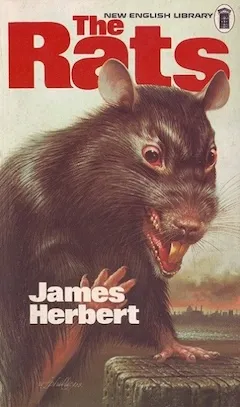
The Rats is one of those bits of "scarred for life" media that people in the pre-internet era would read at a far too early age, sacrificing the dewy innocence of their childhood on the slightly foxed altar of sensational genre fiction 1. As with most adolescent milestones, I came to Herbert's opus slightly later - I was probably fifteen or sixteen, rather than, say, ten - but it was still a shocking experience. I had read horror before, but nothing this ruthless and gruesome.
Herbert wrote a couple of dozen books through a busy career; The Rats (1974) was his first and probably best known. (There was even a computer game.) There is a proper story - briefly: the fight against giant super-intelligent mutant rats who are threatening to take over London - but the main attraction is the gory set pieces. If Herbert is a master of anything it's introducing a character, sketching a vaguely humanising background, then having hundreds of rats gnaw out their innards. The locations are all workaday, familiar - a school, a cinema, a packed commuter train - and in a weird way the mass casualty rat attacks are eerily similar to the spree killings and terrorist attacks of our present - except instead of incels or jihadis it's thousands upon thousands of giant rats.
The Rats is only 200 pages, and you know Herbert means business because you've barely reached page ten and already a baby and a puppy have been torn to pieces. The authorities in rat-panicked London are caught unawares; the initial attacks are alarming but wishfully explained away as anomalies. The unlikely hero of the piece is Harris, a high school teacher in London's downtrodden East End. Harris is your classic no-nonsense pragmatist, indeed he's so pragmatic that he doesn't bother with such a frivolous thing as a first name. Even his girlfriend calls him Harris. A man very much of his time, Harris is a prick and his attitude towards women is, uh, unreconstructed. When we first meet him he's reflecting on life as a lowly teacher, but is forced to concede, having noticed the breasts of some fourteen-year-old girls running past, that "Anyway, the crumpet's good". Later he reminisces about the night in high school when he and six of his mates "had it off" with a girl from their class. Looks like the real rats are heterosexual men, am I right?
These days, despite or at least in addition to the schoolgirl-ogling, Harris has a steady girlfriend, Judy, and is coming around to the idea of true love, helped along by sharing with Judy regular, and apparently simultaneous, orgasms. (Herbert loves writing sex scenes, which is a pity as he is terrible at them.) But then the whole mutant rat thing takes off and Harris finds himself at the centre of the government's anti-everyone-getting-eaten-by-rats campaign. This is because he grew up in the East End and "knows the area", unlike the entire government, military, police and civil apparatus who apparently couldn't find working class Stepney on a map.
Take away the gore and the more egregious misogyny and The Rats owes a lot to the "cosy catastrophes" of John Wyndham and John Christopher2. The process of combating and ultimately defeating the rats (or do they??) involves a lot of meetings with humourless technocrats and governmental officials, most of whom are fellow members of the surnames-only club. At street level things are of course squelchier but there's a lot of stiff upper lip courage and Blitz spirit. If anyone smiles, they do so "tightly" or "grimly".
The novel approaches a political stance: The establishment that is desperately trying to end the horror is the same that neglected and ignored the areas in which it has taken hold. Herbert's descriptions of the East End, with its literal bomb sites and overgrown "jungles" are a deliberate undercutting of the image of vibrant Swinging London. But Herbert's - and the characters' - main concern is the giant rats that are eating people en masse. Which is fair enough.
Was I shocked anew by The Rats? Not at all. It reads as quite tame nowadays, aside from the sexual politics. The idea of a child picking up a James Herbert from her parent's nightstand and being initiated into a strange adult world of lavishly described horrors3 seems almost quaint. It's a lot of fun, though, and I can feel myself being drawn, inexorably, as a hungry rat is drawn to a plump, juicy baby, to the sequels. More anon assuming the rats don't get me.
Also in the moral defloration canon: Clan of the Cave Bear, Flowers in the Attic, and take your pick of cocaine-era Stephen King and the bibliography of Jilly Cooper. I'm collating a reading list as we speak.↩
A debatable term: Wyndham and Christopher's books are often far from "cosy", unless you consider ambulatory carnivorous plants "cosy".↩
And that's just the sex scenes.↩