Lair (James Herbert)
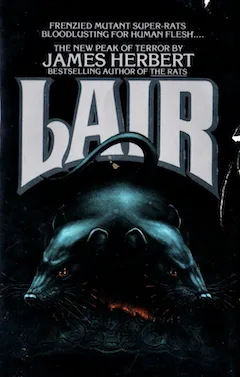
At the conclusion of The Rats (read my review), London's mutant rat population had been eradicated by poison gas. Yet troubling questions remained. What if, despite the assurances of those in authority, some of the rats survived? What if they'd fled elsewhere to regroup? And what if the regular mutant rats were being led by super-mutant rats, with bulbous, veiny, pig-like bodies, and two heads? What then?
In Lair, Herbert dares to imagine and the result is... underwhelming. The scene is Epping Forest, on the northern edge of London, where strange goings-on are going on - and on, and on. The first book was an unstoppable sledgehammer with an irresistible rhythm: introduce character, have them horribly slaughtered, repeat. Herbert tries something different with Lair, with various characters having near miss encounters with the rats and not being immediately killed. It's meant to build suspense but it goes on for far too long, and in any case the reader knows exactly what is behind all of the strange phenomena. (It's the rats.)
The hero of this one is rat exterminator Luke Pender, a man who lost his family in the London rat massacres and is now on a mission to destroy all of rodentkind, mutant or otherwise. Luke is a somewhat more appealing - and less pervy - character than The Rats' Harris, but he is similarly pragmatic, brusque, and determined. Not even his funny name will stand in his way.
'I'm sorry, Mr Pender...'
'Luke,' he told her.
'Luke?'
'Short for Lucas.'
'Lucas?' She couldn't help smiling.
'Not my fault. Parents. I was conceived on honeymoon in a place in lower Italy. Lucania.'
Ah yes, that most recherché of names, Lucas.
Anyway, Luke has overcome adversity - dead family, forrin-sounding name - and is now set to take on the mutant rats, provided he can convince the powers that be to heed his warnings. What will it take? I'll tell you. An ONSLAUGHT.
After seventy numbing pages of buildup, Herbert finally drops some gore. You can almost feel his glee at not having to be doing with all this character shit as he lovingly describes a tent full of orphans being chomped and a pair of cheating lovers getting torn to shreds in their makeshift love nest. The plot picks up now, as Luke and his fellow grimly smiling humourless men begin the long fight against the newly resurgent rats. Along the way Luke falls in love with Jenny, a studious and sexy staff member of a local conservation centre; you will be pleased to know that, like Harris in The Rats, Luke is a master of the art of the simultaneous orgasm.
Speaking of sex scenes, Herbert sure does write them. There's one in particular that is so confusing it's almost impossible to visualise what's going on. It only involves two people, but the mental image is of a contorted mass of limbs and spines, like a game of nude Twister crossed with the orifice-punching orgy from Society. It's a baffling bit of writing; by comparison, Luke and Jenny's sex scene is a model of restraint and logistics.
In some ways Lair is a better novel than The Rats. It is more carefully shaped, the characters are (marginally) more interesting and believable. But James Herbert has "a very particular set of skills", and here he's so busy doing novelistic things that he loses the streamlined grungy sleaziness that makes The Rats so entertaining.
Reducing the splatter has the unfortunate effect of revealing the sloppiness of Herbert's prose, best summed up by the moment where he writes "Then the indescribable happened" - and proceeds to describe what happened, at length. He really struggles with synonyms for his antagonistic monsters. I get that he didn't want to have the word "rats" in every second sentence, but his solution - constantly substituting the word "vermin" - makes the repetition even more noticeable. "Vermin" appears 98 times, "mutant" 54 times, "rodent" or "rodents" 40. This is a 240pp book, so you are reading the word "vermin" a lot, including at least one instance where it is used three times in a single paragraph.
Herbert also has a strange habit of referring to characters by their professions, even when the profession is irrelevant to what's going on. Pender is "the ratcatcher", which, although it becomes repetitive, is at least germane to the action. But there are two characters who are introduced as tutors, and who are then referred to either by name or as "the tutor" when the fact of them being tutors has nothing to do with the plot or anything the characters end up doing. The word "tutor" appears 87 times, which is a lot in a book that has nothing to do with tutors or tutoring. Herbert's is an unforgiving universe: even in the aftermath of your heroic, horrible death, you will still be referred to by the occupation you were introduced by 200pp earlier.
Pender closed his eyes as the slumped form was once more covered by the jostling vermin and when he opened them all he could see of the tutor was a hand, the fingers missing, twitching in the air above the gorging bodies. The tutor was dead - of that there could be no doubt - and the macabre action was caused by the elbow tendons being gnawed.
In the end, the rats are vanquished (or are they??) and the right people have orgasms and James Herbert presumably got a big cheque and a new leather jacket. Lair isn't completely awful, but I would probably tap out of the series at this point if I wasn't aware that the next book, Domain takes a dramatic leap into the speculative. Whether that results in a better book remains to be seen.