Domain (James Herbert)
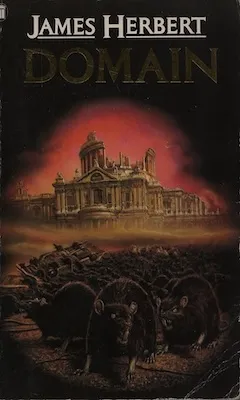
The most shocking thing about Domain, the third novel in James Herbert's Rats trilogy is that it's a genuinely enjoyable, often gripping novel of action and suspense. The first book, The Rats (my review) was an entertainingly rough and ready affair, gory and sleazy by turns. The sequel, Lair (my review), was a lazy book: a rehash of the original that improved on the formula in some ways, but was hamstrung by the feeling that Herbert couldn't bring himself to give a shit. And really, where is a story like this meant to go? Imagine an endless succession of sequels in which the rats regroup and overrun different locations - a cruise ship, a space station - before being vanquished - or are they?? How tedious. It must have seemed so to James Herbert because when he sat down to write a third Rats book, he had the brilliant idea to just fucking nuke the planet.
The chronology isn't given, but the reader infers that we're a few years distant from the original mutant rat attacks. There have been no further encounters, no sightings, and the whole episode has been memory-holed in the way mass trauma often is. Of more immediate concern is the trouble a-brewin' in the Middle East, where the US and the USSR are rattling sabres at one another over Iran. We don't get much of the geopolitical background; rather, we're at literal street level when the warheads start falling. The book's hero, Steve Culver, a civilian helicopter pilot with requisite tragic backstory, is caught in the chaos, and ends up assisting a minor government official, Dealey, who has been temporarily blinded by the atomic flash. Dealey says he knows of a secret shelter, and the two men head into the subway. There they find mass panic - and not only because of the whole end of the world thing. There is something living in the tunnels beneath London, something that has been breeding, biding its time, something that... Look, it's the mutant rats. You knew that.
Culver and Dealey make it to the shelter, along the way picking up a young woman named Kate, who is Culver's designated love interest. Others are already in the shelter: engineers, technicians, a doctor. It is one of dozens throughout London and the wider country, established for an end times scenario. The idea is that when the fallout disperses after a few weeks and the all-clear sirens sound, the survivors will emerge blinking from their subterranean sanctuaries to rebuild civilisation. It's already a somewhat fanciful notion, but in the world of Domain it is rendered impossible by the existence of millions of ravenous mutant rats, largely immune to the effects of radiation, and apparently keenly aware that the balance of power in their conflict with humanity has tipped dramatically in their favour.
There's a strange tension in Domain, especially in the first half as the characters come to terms with what man hath wrought. The nuclear war aspect of the story clearly comes from a place of reflection - and great fear - on Herbert's part, and his characters give full vent to their confusion and anger. The devastation of London, the millions dead, the almost-dead survivors encountered in the ruins, the entire civilisation irrevocably lost - all of this is, in Herbert's sober telling, utterly horrific and affecting. In contrast to the earlier books, there's a maturity to the characters, an interiority that gives their actions more weight. Don't get me wrong, he's not suddenly Henry James, but it's nicely done.
The tension arises when this all-too-plausible apocalyptic scenario collides with the book's other purpose, ie. the mutant rats and their ongoing war against humanity. I say tension, but I don't meant to suggest that it doesn't work. The fact that the government has planned (however haphazardly) for nuclear war but completely neglected the possibility of other dangers - not least the marauding rats that killed hundreds of people a few years earlier! - is of a piece with the cynicism towards authority in the previous books. It's more that the nuclear apocalypse makes the killer rat stuff feel a bit less fun than it was previously. I suppose nuclear war does tend to have that effect on most things.
Inevitably the rats attack the shelter, forcing our heroes to flee across the city in an ever-diminishing group. The action is unrelenting, dense, pure survival horror. The characters are an interesting bunch: Culver is at first glance your typical taciturn protagonist, but he possesses hidden depths. Kate might be the token woman - and she is of course always "the girl" - but she is smart and resourceful. Herbert even discreetly draws a veil over Culver and Kate's bedroom - or quiet-place-over-near-the-burnt-out-ruins-of-a-bus-shelter - activities. We don't even learn the timing of their respective orgasms. It's most un-Herbert-like!
Also improved is Herbert's prose. He still repeats words and phrases, but the repetitions are dispersed more evenly through the text, thus less annoying. We don't even get a "vermin" until page 62. Whether it's Herbert improving as a writer, or the efforts of an editor, or both, the writing is simply better.
I have two main complaints. The first is the book's length. At 400pp it is almost as long as the first two books together, and while there's always plenty going on, I do think it could have been trimmed a little. My second complaint, really more of a minor qualm, is the ending, which feels like a writer running out of oomph rather than a natural conclusion. Then again, and without spoiling what happens, an alternative ending would probably have meant killing off everyone, and that's a bit bleak even for James "Have you ever wondered what a rat could do to a human eyeball?" Herbert.
A decade after Domain, Herbert published a continuation of the Rats story in a graphic novel called The City. Long out of print, you can find it online and if you're a Rats devotee it's probably worth the fifteen minutes it takes to read. I'm not kidding: it's about sixty pages, with very little in the way of captions and dialogue. The minimalist story is about a mysterious traveller, kitted out in a kind of steampunk suit of armour, who returns to post-apocalyptic, rat-infested London in search of his wife. Would you believe that things don't go well? The best thing about The City is Ian Miller's art, which at its best is like Heironymous Bosch channeling Francis Bacon. Otherwise, it's thin gruel, adding little to the Rats series and otherwise not really justifying its existence. For Rats completists - of which I am apparently one - only.